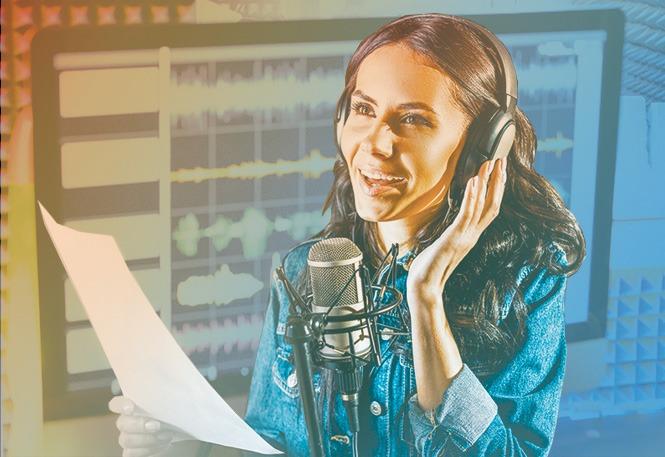
Voices & Media Solutions is a Portuguese voice production company that develops professional voice cloning projects for businesses. Every cloned voice starts with a professional voice talent, actor or presenter who gives express consent and signs a licence agreement with clear terms of use. The resulting voice model generates new voice-overs from text, in your brand’s voice, for IVR systems, virtual assistants, e-learning, corporate video and audio guides.
Voice cloning solves a concrete problem. The right voice for your brand exists, with the tone, style and expressiveness you are looking for, but the talent behind it is not available at any time or for any volume of production. With cloning, the digital model of that voice is available whenever you need it, for whatever you need, within the limits agreed in the licence.
Ideal for:
Formal agreement with the voice talent: consent, contract and clear terms.
Licence defined upfront: period, contexts, markets and exclusivity.

Usage-based fee, ensuring fair compensation for the voice talent in proportion to use.

Professional quality for corporate voice-over, e-learning, IVR, virtual assistants and digital content.
A documented process that protects clients under European AI regulation.
ISO 9001 certified company.
Voice cloning is the creation of an artificial intelligence model trained on the sound characteristics of a specific person: their tone, intonation, rhythm and natural pauses. Once trained, the model generates new voice-overs from text, in that voice talent’s voice, without the need to record again in the studio.
The technical process has three stages:
At Voices & Media Solutions, voice data is recorded in our own recording studio, with professional voice direction. The quality of the source data is the factor that most influences the final quality of the cloned voice.
Voice cloning without consent has already caused real harm to professional voice talents in several countries: voices used in campaigns they never approved, in contexts they never authorised, for fees they never negotiated. That is why our service model rests on four principles:
This model is not only more ethical, it is also safer for the client. A company that uses a cloned voice without a formal agreement is exposed to growing legal risks as European regulation on artificial intelligence, data protection and personality rights advances. A documented, contractually sound process protects your business.
| Stage | What it includes |
| 1. Defining the use | Selection of the voice talent, definition of the contexts of use and formal agreement with the voice talent. |
| 2. Set-up (2 to 4 weeks) | Recording of voice data exclusive to the project in the studio, model training and validation. |
| 3. Licence | Period of use, authorised contexts, markets, exclusivity, usage-based fee and renewal terms. |
Voice cloning is not the right solution for every project. It makes sense when:
If your company does not yet have a brand voice and wants to create one from scratch, cloning may not be the best route. In that case, creating a custom AI voice is a different and faster process. Our team will help you work out which approach best suits your project.
All uses are subject to the terms agreed in the licence.
Don’t have a voice talent to clone yet? Start with our voice bank, with more than 500 professional Portuguese voice talents and more than 2,500 native voices from over 70 countries. Not every voice talent agrees to license their voice for artificial intelligence, so we indicate which professional voices are available for cloning in each language. Define the voice profile you are looking for and our team will help you find the right voice for your business.
We explain the process in detail, help you work out whether voice cloning is the right solution for your project and, if it is, send you a proposal with the set-up, licence and fee model that suits your needs.
Frequently Asked Questions about Voice Cloning
They are two distinct processes. Voice cloning starts from a real voice talent — a specific person whose sound characteristics are replicated in an AI model. The result is a voice that sounds exactly like that person. A personalised AI voice creates a voice from scratch, without starting from a real person, with characteristics defined by the client. Cloning is the right path when an established human voice profile already exists. A personalised AI voice is more suitable when the brand wants to create a new sonic identity without association with a specific voice talent.
Yes, always. The voice talent's consent is an absolute requirement in our process. If the talent does not agree — whether because of the nature of the project, the client's profile or the proposed terms — the project does not proceed. There are no exceptions to this rule.
No. The licence of use is defined upfront and has a set period. Use outside the defined period or contexts is not authorised. When the licence expires, it can be renewed by agreement with the voice talent under the terms in force at that time.
For the majority of commercial applications — corporate voice-over, e-learning, IVR, digital content — the quality is professional and indistinguishable to the average listener. For content where emotional nuance is very demanding, such as high-impact advertising or creative content, studio recording remains the best option. Our team helps assess whether cloning is suitable for each type of project.
It depends on the voice talent's availability and the complexity of the model. Typically, between the recording sessions for data collection, model training and validation, the process takes two to four weeks. For urgent projects, we assess on a case-by-case basis.
Yes. We select a voice talent from our professional voice bank who matches your brand profile and is available for cloning projects. We present options, the client chooses and, after confirming availability and the talent's agreement, we proceed with the cloning process.
Yes, provided it is done with the voice talent's formal consent and a contract that clearly defines the terms of use. The European regulation on artificial intelligence establishes growing requirements for transparency and documentation. Our process was designed precisely to meet these requirements and protect both the client and the voice talent.
Clients


 Professional Voice Bank
 Contact
 Quote Request
 Professional Voice Bank
 Buy
 Client Area